Build what you intended.
You can prompt an agent to build a feature. The harder part: knowing whether what it built is what you meant. IntentDocs defines what “correct” looks like — acceptance criteria your agent checks and you can verify — before the build starts.
Works before you open Cursor. Before a repo exists. An interview turns your idea into stories, data models, and acceptance criteria — wired to your agent via MCP so every session starts from the same plan.

Hi, I'm Spec. I'll generate your specs and hand them to your agent via MCP. You get the build. I log what happened.
When intent is fuzzy, software gets expensive.
AI agents are powerful. But without the right context, they make the wrong assumptions — confidently, and at speed.
See why intent matters →YOU TELL CURSOR
“Add account deletion.”
It doesn't know you decided deleted accounts need a 30-day recovery window.
YOU TELL CLAUDE
“Change checkout.”
It doesn't know you decided to keep the guest flow and never add coupon codes.
YOU TELL CODEX
“Fix the onboarding.”
It doesn't know onboarding must complete in under three screens.
The solution
From idea to implementation. One source of intent.
IntentDocs becomes the system of record for your product intent — available to every coding agent, every session, over MCP.
YOU
“I want to build passwordless auth with Google sign-in…”
◉ INTENTDOCS
_context()
·-·-·-·→
CODING AGENTS
… and more
CODE
>_
You don't need to write a 40-page PRD.
Tell IntentDocs what you're trying to build. It interviews you like a great product partner — asking the questions that expose missing decisions, edge cases and assumptions.
See an example interview →◉ INTENTDOCS
RESULT
REQUIREMENT
Users can authenticate without passwords.DECISION
Do not introduce password credentials.CONSTRAINT
Existing accounts must match by verified email.ACCEPTANCE
Google sign-in works from signup and login.Your agent's memory resets. Your product's doesn't.
Every decision, constraint and requirement becomes durable context — available to whichever agent you use next.
SEP
Why we chose passwordless auth
OCT
Why orgs have one owner
NOV
Why billing uses Stripe Checkout
JAN
Why account deletion takes 30 days
“Refactor authentication”
Claude already has the decisions that matter.
WITHOUT INTENTDOCS
WITH INTENTDOCS
Never heard of MCP?
It's a cable between your spec and your agent.
You paste one config block once. From then on your agent can read the plan and write progress back — no copy-paste, nothing going stale.
YOU
Plan in the UI
MCP SERVER
One source of truth
AGENT
Builds + reports
Prompts only
Your agent is guessing — and so are you.
With IntentDocs
A spec it reads live, and reports back into.
Three steps, about ten minutes.
Then every session your agent starts already knowing the plan.
Step 1
Talk through the idea
An interview turns it into a story map, data model, acceptance criteria and build order.
Step 2
Paste the config
One block, once. Your agent gains 19 tools for reading and reporting.
{
  "mcpServers": {
    "intentdocs": {
      "command": "npx",
      "args": ["intentdocs", "mcp"]
    }
  }
}
Step 3
Build story by story
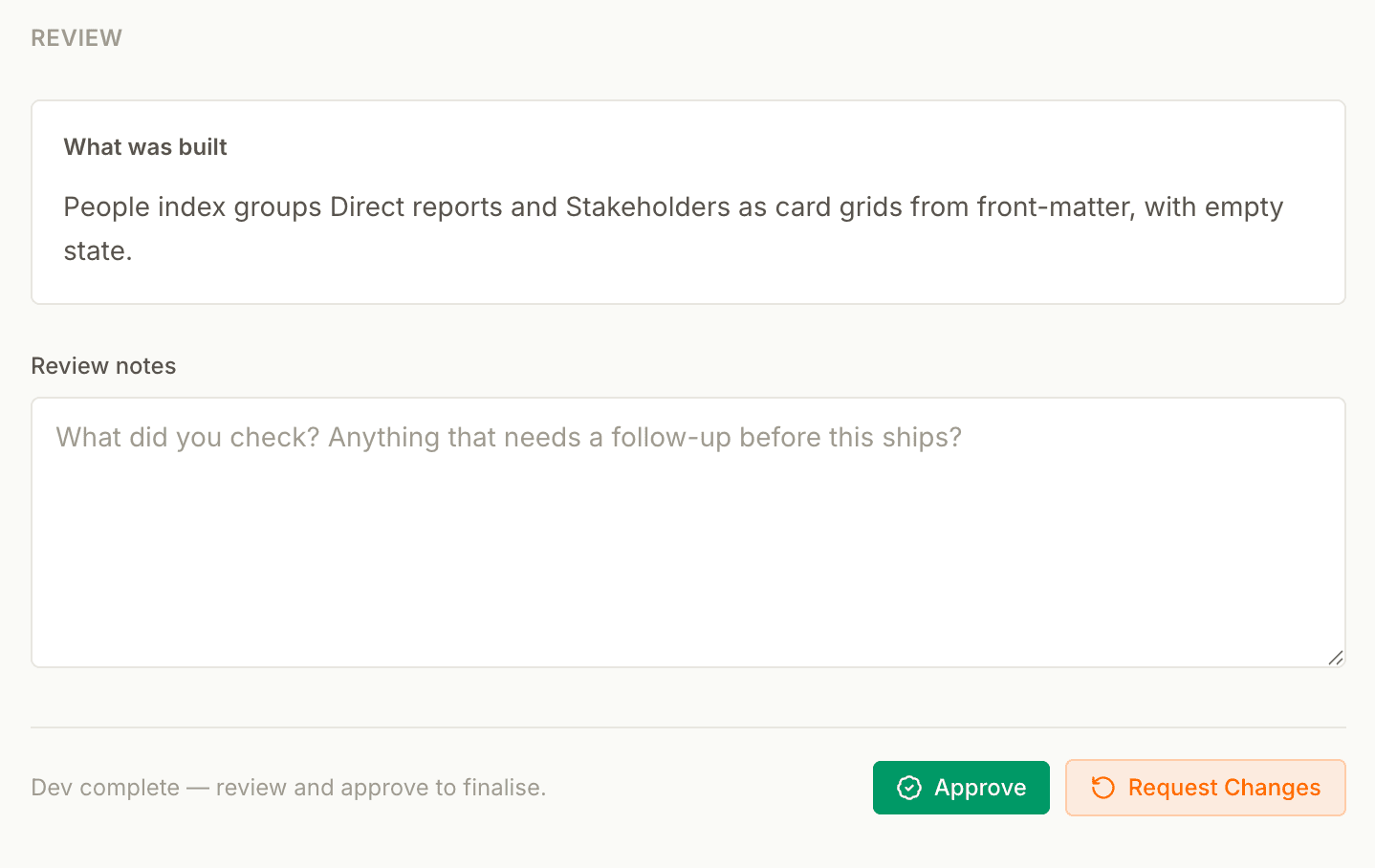
Criteria get checked off, decisions get logged, and you can see it all in Review.
You think in the UI. Your agent works in the repo.
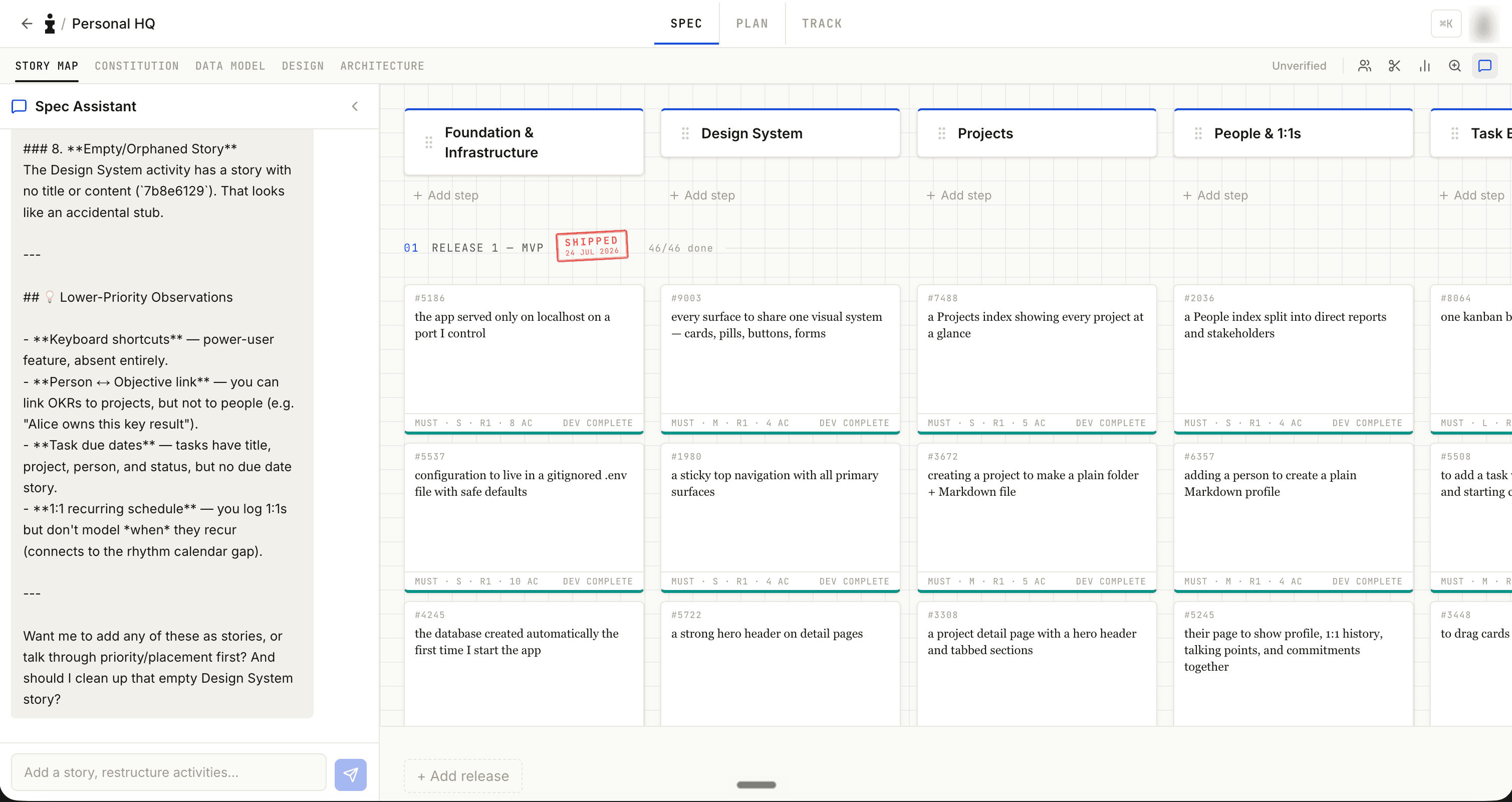
Same source of truth, two interfaces. Drag a story, change a priority, rewrite a criterion — the agent picks it up on its next call.
Story map canvas
Review — built vs planned
What the agent can do
The part prompts can't give you: a record.
Evaluability
See acceptance criteria checked off story by story — and deviations flagged. Know if it's right without reading the code.
Repeatability
Edit the spec, not the prompt. The agent adjusts on its next run.
Portability
INTENT.md sits in your repo, in plain markdown. Switch agents whenever you want.
Built for founders building with AI — before the first commit.
You can generate code. You can prompt an agent to build a feature. What's hard: knowing whether what it built is what you actually meant. IntentDocs is the spec layer that defines “correct” before the agent starts — readable acceptance criteria, story by story, that you can check without reading the code. Senior engineering rigour without the senior engineer.
Start free. Pay when it's load-bearing.
Trial
7 days
£0
- ✓ 1 project
- ✓ Full agent interview
- ✓ CLI access
- ✓ Every template
- ✓ No card required
Pro
PopularMost popular
£29/mo
Billed £290/year
- ✓ Up to 10 projects & unlimited stories
- ✓ intentdocs CLI
- ✓ Custom spec templates
- ✓ Priority support
Team
For teams
£19/seat/mo
Billed £190/seat/year
- ✓ Everything in Pro
- ✓ Team workspace
- ✓ Workspace invites
- ✓ Shared spec templates
All plans include the intentdocs CLI, story map canvas, MCP server, and spec sync
I've never set up an MCP server.
You won't have to. Run one command, or paste one config block — the remote option needs no CLI at all.
Am I locked in?
No. INTENT.md is an open, CC-BY format in plain markdown, committed to your repo. It works without an account.
Does this slow me down?
Ten minutes up front replaces the re-explaining you do every session — and the rework when the agent guesses wrong.
I don't have a codebase yet. Does this work?
That's exactly when to start. IntentDocs works before the first line of code — the interview produces acceptance criteria, and you give the spec to your agent when you're ready to build.

Give your agent something to build against.
Spec your next feature in ten minutes, then let Claude Code do the rest.